

Writing about the pivotal comic “Judgment Day!”, which debuted in EC Comics’ Weird Fantasy #18, Daniel Yezbick points out that while EC’s works “trafficked in largely repetitive, openly grotesque, and often sexist power fantasies,” they also “became one of the few voices in any medium with the chutzpah to present openly subversive morality plays that regularly questioned concepts of liberty, equality, faith, and justice.” Through this subversive nature, they used their works, from horror to science fiction to realistic narratives, to, as Mike Benson writes, “make moral statements about bigotry, prejudice, and racial inequality.” While Al Feldstein and Joe Orlando’s “Judgment Day!” address these issue head on, others such as Feldstein’s “A Little Stranger” and Feldstein, Orlando, and Bill Gaines’ “The Green Thing!”, do it underneath the surface. Today, I want to look at Gaines, Feldstein, John Severin, and Bill Elder’s “Counter-Clockwise” which appeared in the same issue as “Judgement Day!”
“Counter-Clockwise” begins with a large panel showing a man and his son encountering an alien being that has emerged from a ship. The father holds a gun out, pointed towards the approaching being. The son, Ron, narrates the story, and and insert panel on the first page flashes back to the father and son sitting in the theater and Ron telling his dad he wants to talk with him about something important. After the movie, they go out into the country and Ron tells his dad that he wants to become a space pilot, and his dad tries to talk him out of it. As they talk, they see an alien ship fall to earth. They approach the ship, and as the alien emerges, Ron’s father shoots it dead. however, after their encounter with the alien and the discovery of the ship allows Ron to go into the service as a space pilot and he flies to a distant planet for his first mission to a planet that spins counter-clockwise. On the planet, he becomes ill, covered in sores, and returns to earth. Upon returning to earth, he lands in a field and his younger self stands their with his father. His father shoots him and kills him. This happens because the rotation of the planet also reversed time, and Ron landed back on Earth ten years earlier.
“Counter-Clockwise” mirrors, narratively, a number of stories one would find in Weird Fantasy. What makes this story interesting, though, is the way that race and the othering of individuals sits right underneath the service of the fantastical narrative. We see this aspect early in the story when Ron and his dad first encounter the “being,” but after we get to the end and look back, it becomes even more evident, specifically through the language that Ron uses to describe, what we come to learn, himself. His initial descriptions position himself as the other, as an threatening “alien” hellbent on harming him and his father.
The first panel where we see the future Ron positions us inside the ship, looking outwards towards the younger Ron and his father in the field as they scream in fear. We gaze over the shoulder of the future Ron, seeing his right hand, with elongated nails that look like claws, and a monstrous head. Narrating the story, Ron tells us he “stopped dead” in his tracks as him and his father caught site of “it.” The use of “it” immediately others the future Ron. Granted they do not know this at the moment, but by using “it” instead of “him,” “her,” or any other identifier, Ron makes himself into a “being” that can he can destroy if he feels afraid.

The next panel switches perspective, placing us in the position of the young Ron and his father as the future Ron approaches them. Here, Ron states, “It was horrible . . . the most horrible creature I’d ever seen! It rushed at us, its eyes burning, its loathsome flesh crawling . . . screaming. “Again, Ron position himself as a threat, even using “it” again instead of another pronoun or appellation. While future Ron has lost the ability to communicate, the young Ron takes the future Ron’s actions as dangerous and a threat, thus sanctioning what comes next when Ron’s father shoots his own son. The perspective, since we don’t know the end yet, makes us, as readers, fearful of the future Ron as well because we see him as a threat to the two “human” characters in the story, characters who we identify with due to our similarities.
When Ron’s father shoots his son, we see future Ron fall to the ground as the young Ron describes his future self as a “disgusting thing, rushing at us with hate and fore in its eyes.” As future Ron lies on the ground, dying, we see a closeup of his face, writing in pain, as Ron tells us that “[t]he thing twitched, lifted its ugly head, looked at me for a burning moment, then closed its eyes.” Again. the narrator Ron distances himself from future Ron by calling him a “thing,” describing him as “ugly,” and continuing to use “it” when referencing him. All of this language makes it easier to enact violence against the future Ron. As well, young Ron and his father’s interpretations of future Ron’s actions make it easier to shoot first and ask questions later, not even trying to engage with future Ron.

The end of “Counter-Clockwise” drives all of this home, especially through the perspectives that Severin and Elder use to position as readers within the story. The start of the sequence begins in a similar manner to the first encounter, except that we only see through the door, without the back of future Ron’s head. He lands and looks “down at the young boy and the man rushing toward the ship.” The language changes here from earlier. In the first telling of the encounter future Ron rushes at younger Ron and his father, but here younger Ron and his father are “rushing” at future Ron. Ron narrates that he “did not realize how horrible [he] must have looked to the,” and he tries to communicate with them, telling them he his human. He sees “fear and loathing in their eyes,” again another reversal from the first telling of the encounter.
The next panel shows Ron’s father pointing the gun at us, the reader, in the position of future Ron. Behind Ron’s father, the younger Ron stands, looking directly at us with anger in his face and a raised fist as his father pulls the trigger. This moment stands out because we see future Ron’s perspective, which we do not get during the telling of the first encounter. We experience what future Ron experiences, the anger and fear in younger Ron and his father’s eyes. We become the other. We become the oppressed. We move, over the course of the story, from the individual who dehumanizes others to the individual being dehumanized. This reversal is powerful, especially with the positioning of ourselves as readers, in the position of future Ron as his own father shoots him dead.
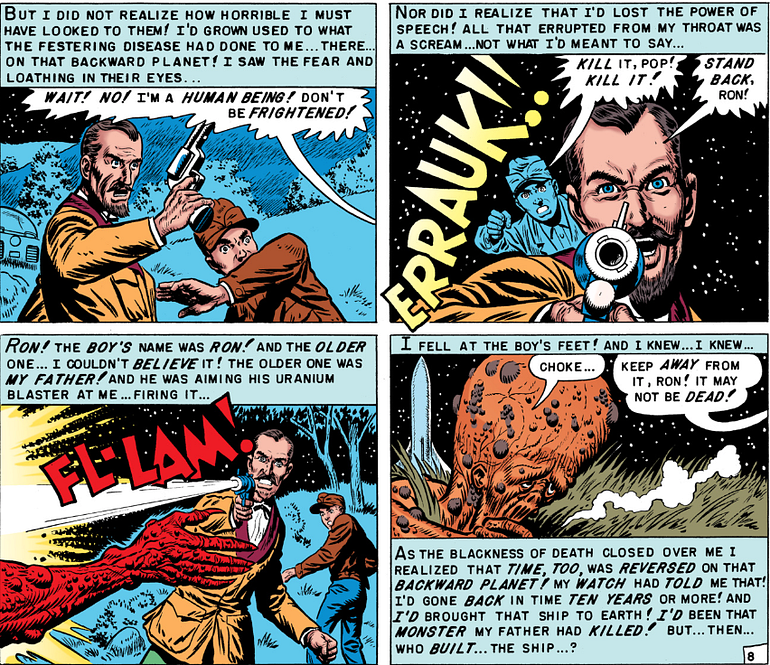
When Ron’s father tells him to stand back, future Ron realizes that he sees himself and his father. At this moment, we zoom out as the shot rings out and we see future Ron’s arm in the foreground of the panel while Ron’s father and young Ron stand further away. Again, we are in future Ron’s position, experiencing the filicide in real time. The final panel, where we see future Ron dying, mirrors the earlier one in the story. However, in the earlier panel, we do not see much expression in future Ron’s face, but in the final panel, we see his eyes closing and his mouth downturned as he thinks about what has happened. We see his humanity. We are his humanity.
“Counter-Clockwise” addresses the ways that we other individuals, the ways that racism works to dehumanize. It does this through a narrative that actively puts us in each position: the oppressor and the oppressed. It does all of this over the course of eight pages, pointing out the ways that when we immediately other someone and cast them as an enemy we suffer. What are your thoughts? As usual, let me know in the comments below. Make sure to follow me on Bluesky @silaslapham.bsky.social.
 Interminable Rambling