
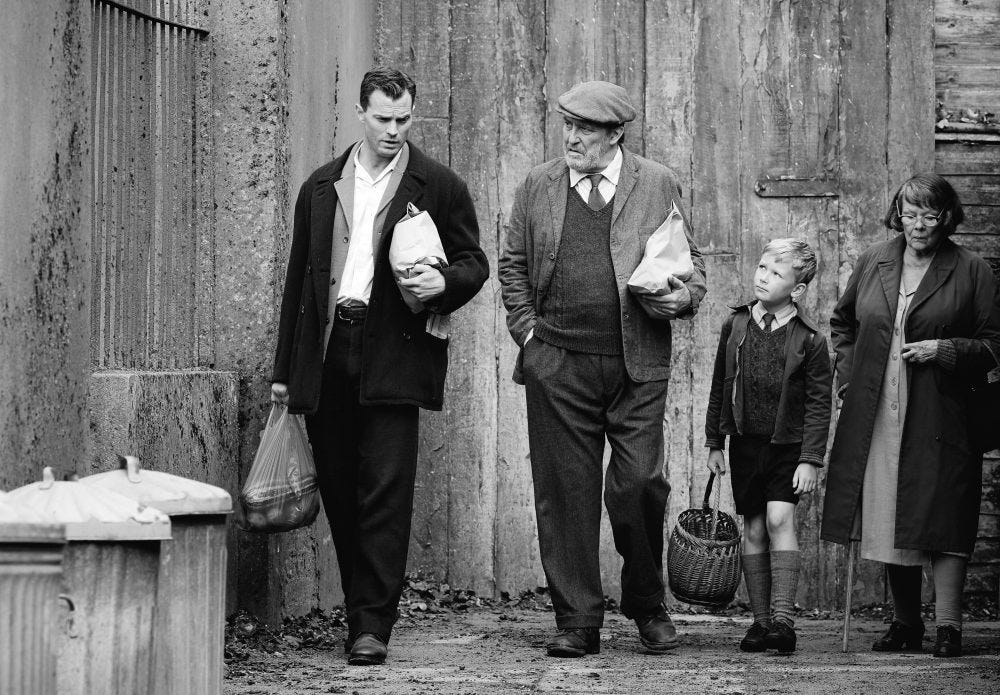
Near the end of Kenneth Branagh’s Belfast (2021), a coming-of-age story set at the start of The Troubles in Belfast, the nine-year-old protagonist Buddy talks with his grandfather at the hospital. During their conversation, Buddy tells his grandfather that his family may move “over the water” because his dad found work in England; however, his mom tells him that if they move there then the English wouldn’t understand the way he and his family talk. His grandfather wisely tells his young grandson, “If they can’t understand you, then they’re not listening, and that’s their problem.” He continues by telling Buddy that when he worked in Leicester he put on a different accent every day to annoy the English he worked with, and even though they never knew who he was, he knew himself, and that was all that mattered.
Between the late 1960s and 1998, sectarian violence, centered around religious and national identities, rocked Northern Ireland, stretching below the border to Ireland and “over the water” to England, resulting in over 3,500 deaths of civilians, British military personal, and members of paramilitary groups. The majority of the deaths, a little over 50%, were civilian casualties. The Troubles didn’t arise, out of nowhere, in the 1960s. Tensions within Ireland and Northern Ireland had been existent since England’s colonization of the island way back in the twelfth century. The Irish constantly fought back colonization, and following the Easter Uprising in 1916, the Irish Civil War from 1922–1923, and other events, the Republic of Ireland arose in 1949. However, Northern Ireland, consisting of six of the nine Ulster counties, did not go along with the Republic of Ireland. Instead, they remained with the United Kingdom.
Under British rule, Catholics and those seeking independence from the United Kingdom faced discrimination and oppression. They marched for their civil rights, but protestant leaders, such as Ian Paisley and the British security forces suppressed these movements, often leading to violent confrontations, including Bloody Sunday in Derry in 1972 where during a protest against the internment of republicans and others without trial the British forces shot and killed, with heavy military force, 14 unarmed civilians. Singing about this moment, 15 years before the Good Friday Agreement, U2’s Bono asks, “How long? How long must we sing this song? How long? ’Cause tonight we can be as one, tonight.”
Stuck between paramilitary organizations such as the IRA and the Ulster Volunteers, between Catholics and Protestants, between republicans and loyalists, and between too many labels and identities to present here, individuals worked to survive, to live life amidst the constant threat of violence. Anna Burns’ Milkman (2018), told from the perspective of eighteen-year-old middle sister in Belfast in the 1970s, highlights this very fact. Middle sister, maybe-boyfriend, third-brother-in-law, and others appear to be disconnected from the politics and from the violence wrought by the political climate. They put up a shield around themselves to keep the violence at bay, but they can’t keep it away. They see it every day and in all of their interactions with family members, friends, and the community.
No matter what one did, middle sister points out, one carried politics with them. She states, “There was a fact that you created a political statement everywhere you went, and with everything you did, even if you didn’t want to.” One’s very existence, through no fault of their own, marked them in some manner. This atmosphere stifles, never allowing individuals to be their true selves because they always exist within the ways that others view them. Even though the novel takes places in Belfast, the structure and lack of proper character names makes it feel like it could be anywhere. Burns uses the novel as a depiction of, as she puts it, “any sort of totalitarian, closed society existing in similarly oppressive conditions.”
Like Milkman, Louise Kennedy’s Trespasses (2022) centers on survival. Kennedy’s novel, though, focuses specifically on what happens when individuals cross the man-made lines of identity that exist to separate them from one another. While Milkman feels more abstract, Trespasses directly details when individuals’ identities and their love for one another cross sectarian lines, resulting in violence and ruin. It also details, through Cushla and the other characters, the psychological cost of living in such a separated society and the impact that environment has on young children.
During this course we will read both Milkman and Trespasses. As well, we will watch Belfast and watch Lisa Barros D’Sa and Gleen Leyburn’s Good Vibrations (2013). Each of these works, set during The Troubles, use art to examine the lasting impact of such violence and oppression. They use art to tell stories of humanity and shared existence. As Meredith MacLeod Davidson puts it: “If we are operating, as Sharon Dempsey suggests, in an absence of institutional and societal truth and reconciliation regarding The Troubles, then all we have to sit with in the end is art, no matter what form it takes. Any intimacy, any time spent with the trauma of it, has meaning, and gets us as close to truth and reconciliation as we can presently muster.” Art helps us see ourselves, others, and the world around us, and that is what these works will do.
During our time in Northern Ireland, we will stay in Belfast and learn about the history of Northern Ireland and The Troubles. We will reach back into the 1700s and beyond, tracing the Ulster counties through lectures from university professors at Queens College and a visit to the Ulster Museum. We’ll visit Derry and go to the Museum of Free Derry and the Siege Museum, seeing the ways that each side presents history and The Troubles in Northern Ireland. As well, we will have lectures on Milkman and documentary filmmaking from faculty at Queens University.
While in Northern Ireland, you will keep a journal, reflecting on what you see, hear, and experience. You will reflect upon your experiences in relation to the texts we read and the films we watch. As well, you will write short responses to the lectures we will attend at from faculty at Queens University. At the end of the trip, you will write an essay bringing all of this together, focusing on something that your learned about Northern Ireland during our trip and from the material that we engaged with over the course.
Primary Texts
Branagh, Kenneth. Belfast.
Burns, Anna. Milkman.
Barros D’sa, Lisa and Gleen Leyburn. Good Vibrations.
Kennedy, Louise. Trespasses.

