
Over the past few posts, I have been looking at the tensions that Simeon feels in William Gardner Smith’s The Stone Face. Simeon leaves the United States for France, seeking refuge and escape from the racist oppression of white supremacy. He finds, as other African American expatriates do within the novel, the “illusion of safety.” This illusion provides a means of escape, a means of allowing Simeon to be himself without having to worry about what others think about him. He does not have to look over his shoulder or couch his words. Instead, he can be his true self. However, this illusion gets shattered when Simeon begins to learn about France’s racism and white supremacy, and this realization causes him to question how he can be in Paris while the Civil Rights Movement occurs back home.
Numerous moments throughout the novel cause Simeon to reflect upon his position, and one of the key moments occurs when he sees a photograph in the Paris Herald Tribune of “five black girls and boys walking with heads held high through a crowd of white adults whose faces were twisted by hatred.” Simeon doesn’t specify the school or town where the photograph was taken. It exists as a representation of countless moments such as Little Rock, New Orleans, Oxford, Athens, and many other cities and towns when African American students integrated schools. The image that Simeon looks at immediately brings to mind the image ofHazel Bryan screaming at Elizabeth Eckford as the latter walks into Little Rock Central High School in 1957.
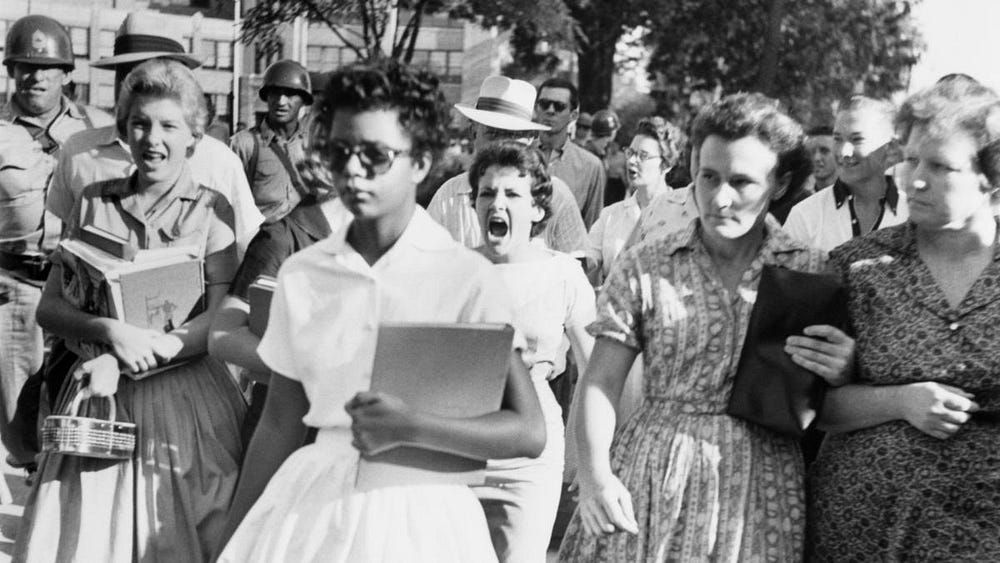
Looking at the photo, Simeon thinks about the soldiers “standing between the black children and the white parents, between the black children and violence, between the black children and death.” Simeon knows the hatred within the contorted faces of the white mob, and he knows that the soldiers stand there not just to prevent the mob from murdering the children walking through the front door of the school. Simeon studies the white faces, and as he does, “he knew them, recognized them: the faces of the stone souls” that make up the stone face painting he has within his study, the painting that serves as a symbolic representation of the actual physical and psychological violence enacted upon him by the same white faces he sees within the photograph.
Simeon thinks about the girl, whom he names Lulu Belle, and the conversations her parents had with her before that photograph. He thinks about the white faces in the crowd screaming vehemently at her, and he concludes, “Them people was scared of little ole her!” Their vociferous hatred arose not deep from within themselves, from the fear at the heart of their very being. They fear Lulu Belle because she tells them something about themselves, and they do not want to face that realization. Instead, they choose to berate and intimidate Lulu Belle because it makes them feel better about themselves.
After talking with Clyde, a white expatriate, accuses Simeon of sleeping with his wife Jinx, Simeon reflects upon Lulu Belle, and he as he thinks about her be becomes disgusted with himself. “He was over here,” the narrator tells us, “comfortable in Paris, leaving the fighting to the little Lulu Belles!” Simeon wonders whether or not he would have had the same courage as Lulu Belle, walking through the crowd of white, grotesque faces. He ultimately decides that he must return, even while others such as Babe question his decision and ask him why he wants to return when integration won’t lead to anything. However, Simeon continues to contemplate Lulu Belle’s actions, and he even receives a letter from his brother, who is working with the NAACP and other organizations. His brother, like others in his family, asks him when he will return to the United States.
Following Ahmed’s decision to go and fight in Algeria, after Ahmed’s brother is killed in the Kabilya Mountains, and after Ahmed returns to Paris and is murdered, along with 200 others, in the 1961 Paris Massacre, Simeon makes the decision to ultimately head back to the United States and fight alongside his brother, Lulu Belle, and others. Simeon decides to return to the United States not out of a feeling of national pride or a lack of anger. He returns “because the Lulubelles were there, America’s Algerians were back there, fighting a battle harder than that of any guerrillas in any burnt out mountains. Fighting the stone face.” Simeon’s reference to Lulu Belle and others as “America’s Algerians” signifies his recognition of the tentacles or white supremacy spread around the world. While he ought to escape it by heading to Paris, he couldn’t flee it’s reach, and his connection with Ahmed and Hossein show him this fact.
At the very end of the novel, as Simeon prepares to sail back to the United States, he takes the canvas out of the stone face and slashes it to pieces, symbolically destroying white supremacy and its actors. He destroys the canvas and throughs into the garbage can, not allowing it to overpower him. Even though he will encounter it and the faces when he returns, he will not let them rule his existence, and he will fight back. Simeon’s act is a culmination of his revelations over the course of the novel and his call to action.
William Gardner Smith, in his unpublished memoir, sums up the tensions in the novel by pointing out the ways that the Black expatriate’s illusion of safety made “it at times harder to live at peace with himself.” The expatriate had to pay a price for this illusion, and “[h]e paid it in a painful tearing of himself from the past. . . . He paid it in guilt. . . . He paid for it, finally, in a sort of rootlessness.” Simeon feels rootless in The Stone Face, and over the course of the novel, his roots return, and those roots pull him back to the United States and to action, just as they do for Ahmed and Algeria.
There is so much more to say about The Stone Face, but I will leave it there. What are your thoughts? As always, let me know in the comments below. Make sure to follow me on Twitter @silaslapham.
 Interminable Rambling