
Writing about the lynching of Mark and Jill, two Black children, at the beginning of Chris Claremont and Brent Anderson’s X-Men: God Loves, Man Kills, John Jennings points out the use of the word “Mutie,” a label that the Purifiers put onto the dangling bodies of the two children. Jennings writes, “the slur “MUTIE” has come to represent for many, all racial, ethnic, homophobic and xenophobic slurs that strive to ‘other’ whole groups of people. This marking of the other has always been important to dehumanization.” Reverend William Stryker stokes the fires that lead to the lynching of Mark and Jill, and to the oppression of other mutants. Stryker uses the Bible and Christianity as a guise to stoke these fears and violently oppress mutants.
I’ve written, years ago, about the opening scene and its connections to history. Here, I want to expand on that post some while also looking, specifically, at Stryker’s reasoning for his anti-mutant crusade and what his language and positions have to say about the world we inhabit. Our first introduction to Stryker comes immediately after Mark and Jill’s murder. We see the building that houses the “headquarters of the worldwide evangelical Stryker Crusade” as Stryker reads Deuteronomy 17:2–5, with some omissions (not in italics below).
2 If there be found among you, within any of thy gates which the Lord thy God giveth thee, man or woman, that hath wrought wickedness in the sight of the Lord thy God, in transgressing his covenant,
3 And hath gone and served other gods, and worshipped them, either the sun, or moon, or any of the host of heaven, which I have not commanded;
4 And it be told thee, and thou hast heard of it, and enquired diligently, and, behold, it be true, and the thing certain, that such abomination is wrought in Israel:
5 Then shalt thou bring forth that man or that woman, which have committed that wicked thing, unto thy gates, even that man or that woman, and shalt stone them with stones, till they die.
This passage, as Bernard Levinson points out in the Jewish Study Bible, that these verses lay out the ways that the Israelites should conduct trials and legal proceedings. While verses 2 and 3 deal with individuals worshiping other gods instead of Yahweh, verse 4 lays out how a trial must proceed. Instead of basing punishment on hearsay, the court must diligently enquire to the truthfulness of the claim. Levinson writes that the verse “provides the procedures to put a vague rumor . . . to the formal test of a thorough inquiry in order to verify its truth.”

Even though Stryker only reads these words to himself, he leaves out the clause in verse four that calls upon individuals to diligently enquire about the veracity of accusations. By omitting this clause, Stryker takes individuals, mutants in this case, as bringing “wickedness in the sight of the Lord” and “transgressing his covenant,” thus they become deserving of death since that have “sinned” against God and his covenant. This reading, though, serves to merely reinforce Stryker’s prejudice, and it stokes the fears and violence within him that he will then relate to the rest of the world through his crusade.
While Claremont doesn’t specifically say that he modeled Stryker off of the founder of the Moral Majority, Jerry Falwell, the similarities exist, especially when we consider that when asked about the how “the conservative politics of the early 1980s” inspired the book Claremont responded, “Not inspired — it’s a matter of structuring the adversary. . . . doing convention appearances, waking up on Sunday morning, turning on the telly and watching evangelical preachers throughout the South and Midwest” influenced the creation of Stryker.
Falwell founded the Moral Majority in large part as a response to the Civil Rights Movement. In 1965 he claimed, “Preachers are not called to be politicians but soul winners.” With “Ministers and Marches,” as well as other sermons, Falwell criticized Martin Luther King, Jr. and other clergy who participated in the movement. Yet, fourteen years later, Falwell would lead the Moral Majority, a movement that interlaced itself with the Republican Party. Anthea Butler points out that while most think about abortion as the issue that sparked the Moral Majority, race served as the impetus. She writes, “Race hatred played the fundamental role in, first, pushing evangelicals toward a ‘color-blind’ gospel, which would provide cover for their racially motivated organizing against the federal government, and, second their push to block implementation of the hard-won gains of the civil-rights movement.”
It is no coincidence that X-Men: God Loves, Man Kills begins with the lynching of two Black kids. As Jennings points out, the X-Men have always served as a stand in for different groups: racial, ethnic, religious, sexuality, etc. Before a Purifer shoots Jill, she asks, “Why?” To this inquiry, the Purifier replies, “Because you have no right to live.” The Purifiers do not enquire about the facts. In reality, there are no facts. Just because Mark and Jill enter the world, as mutants, they deserve to die. They did not choose to be mutants. They did not just to be born. Yet, they must suffer and die because of something they did not choose. They must die because Stryker views them as being wicked in the sight of God and transgressing humanity’s covenant with God.
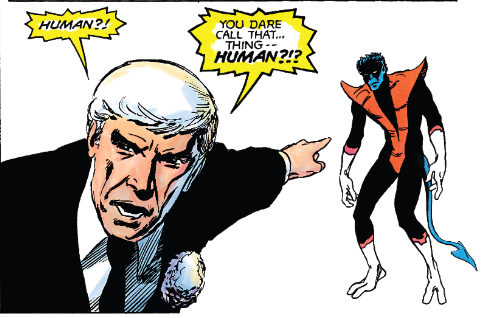
Mark and Jill’s racial identity underscores the role that white supremacy played in the Moral Majority by superimposing it onto Stryker’s Crusade. Stryker and the Purifiers do not comment on Mark and Jill’s race, but by making them African American, Claremont and Anderson highlight the ways that religion has been used to justify the violent oppression of minorities, specifically African Americans. We see this play out even more later in the book when Stryker points at Nightcrawler and asks, “You dare call that thing human?!?” This comment, especially the use of the word “thing” to refer to an individual, dehumanizes Nightcrawler and presents him as less than, through no fault of his own. Stryker picks and chooses, without inquiry, the words he lifts from the Bible, and this pickng and choosing leads to his violent discrimination of those he views as abominations of God.
In the next post I’ll pick up on this and discuss it more, notably looking at the car crash that leads Stryker down his path of religious fanaticism and how the crash causes him to wield the Bible and Christianity as a weapon. Until then, what are your thoughts? As always, let me know in the comments below. Make sure to follow me on Twitter @silaslapham.
 Interminable Rambling