
I first read Ram V and Filipe Andrade’s The Many Deaths of Laila Starr back in 2022, and immediately fell in love it with it. I recently picked up it back up and reread it. During this read through, I kept thinking about the ways that death impacts all of us and the ways that memory sustains us, topics I have been looking at fairly often over the past few years. The Many Deaths of Laila Starr deals with these themes extensively because it follows the avatar of Death, who has been cast to Earth and takes on the mortal form of Laila Starr, as she tries to kill Darius Shah and keep him from discovering immortality and thus eliminating death from existence. There is a lot to unpack in the series, but today I want to focus on the second issue, where Darius faces death for the first time and the avatar of Death converses with Kah, a funeral crow, and then Darius about death about memory.
At eight-years-old, Darius runs away from home, for a night, to attend the funeral of Bardhan, a servant who worked for his family when they lived in a bungalow outside the city. This even turned out to be a monumental evening because “it was Darius’s first real conversation with death, in more ways than one.” Bardhan worked the mango, jackfruit, and sapodilla trees on the Shah’s grounds, and Darius’s parents and grandmother sought to instill in Darius a distinct separation of castes, telling him of his superiority to Bardhan. Darius, though, did not buy this, and he would visit Bardhan often, learning from the man who had a “gentle patience of a man of stone” and had “granite skin and tired amber eyes.”

When the Shahs moved the gated community of Star Garden Heights, Darius didn’t see Bardhan anymore, and the man “disappeared from Darius’s days much in the same way he had entered them, quietly and without fuss.” Darius would hear about Bardhan occasionally, through the “housekeeper’s grapevine,” and one day he heard of Bardhan’s death. Darius stares out of the window at the crows as his parents tell him he can’t go to the funeral because, as his mother says, “we don’t visit their funerals” because they are a lower caste. Darius, staring at the crows, thinks about “the man upon whose shoulders” he had spent entire summers, and he decides to defy his parent’s wishes and go to the funeral, thus running away from home for the evening.
The avatar of Death and Kah sit on the beach watching the ceremony, and Death confesses that she does not understand “the ceremony, the gravity of ritual.” Kah explains to Death that the cermony and everything is “the one thing that is theirs,” what gets left behind when one physically passes. Kah tells Death, after mentioning reincarnations, “The only thing that marks each lifetime then are the memories left behind.” In a panel where we see Bardhan tells Darius not to forget him as he hugs Darius, Kah continues, “To be witnessed by someone else and to be remembered when you are gone. These are the things that belong to mortals.” The memoires belong and remain. Darius does not forget Bardhan, and it is partly his physical passing that pushes Darius on his lifelong journey towards immortality.
After Kah tells Death all of this, Darius walks up the beach and begins to speak with Death, who does not realize she is speaking with Darius. Crying, he asks her, “He’s not coming back, is he?” Death takes sympathy on Darius, and just as she could not kill him when he was baby, she cannot kill him now, in part because killing as a mortal, as Kah tells her, is different because she would have to live with the knowledge of her actions. They sit on the beach, looking at each other as the converse. Darius tells her that he thought of Bardhan as invincible, immortal, as “a god of some sort” who rose up from another world. As a child, death does not completely register with him because he cannot foresee of someone who he pictures as a role model, as someone larger than life, not being there anymore in a physical form.
Darius asks, “Gods can’t die, can they?” Death simply looks at Darius and tells him, “I’ve just learned today that those are two different things, death and going away forever.” She lets Darius know that while physical death may take Bardhan away from the physical world, he has not gone away forever because of the memories Darius and Bardhan created together. Those will not leave as long as Darius keeps them alive in his own mind. Death finishes by telling him, “If life’s an exercise in making memories, no one really goes away as long as they are remembered.” As long as we remember individuals, they do not leave us, they do not cease to exist because we keep them alive.
Before they moved, Darius wanted to give Bardhan two pieces of jackfruit because even though he worked the trees, Darius never saw him eat any. When Darius told his parents what he wanted to do, they told him not to do it because it was “inappropriate.” However, Darius didn’t listen and gave two pieces to Bardhan. On the beach, Darius takes two pieces of jackfruit from his bag and offers them up to the sea as he proclaims, “I won’t . . . I won’t forget him!” Water holds memory, as Kah tells Death earlier. It keeps memory alive. As I sat on the beach in Nice, France, I thought about this, of the people who travelled, years, decades, and centuries ago across the waters of the Mediterranean to that beach or to the beach in Marseille. I thought about the stories contained within those waters as the sea lapped up onto the shore then receeded back to the depths. On the beach, I wrote:
Sitting on the rocky beach in Nice, I watch the Mediterranean lap up onto the shore, spraying me with sea foam as I pick up multi-colored rocks and twirl them between my fingers. The smell of salt hangs in the air, and as the waves crash upon the rocks and retreat, the water rolls back into the sea, causing a cascading sound of rocks clattering together. If energy never dissipates and merely changes with what is affected upon it, then the water I see and the sound I hear have been here for centuries, carrying sailors across these waters to Marseille and beyond. What voices exist within the clear blue waters that lap up against me? Whose voices? Whose stories?
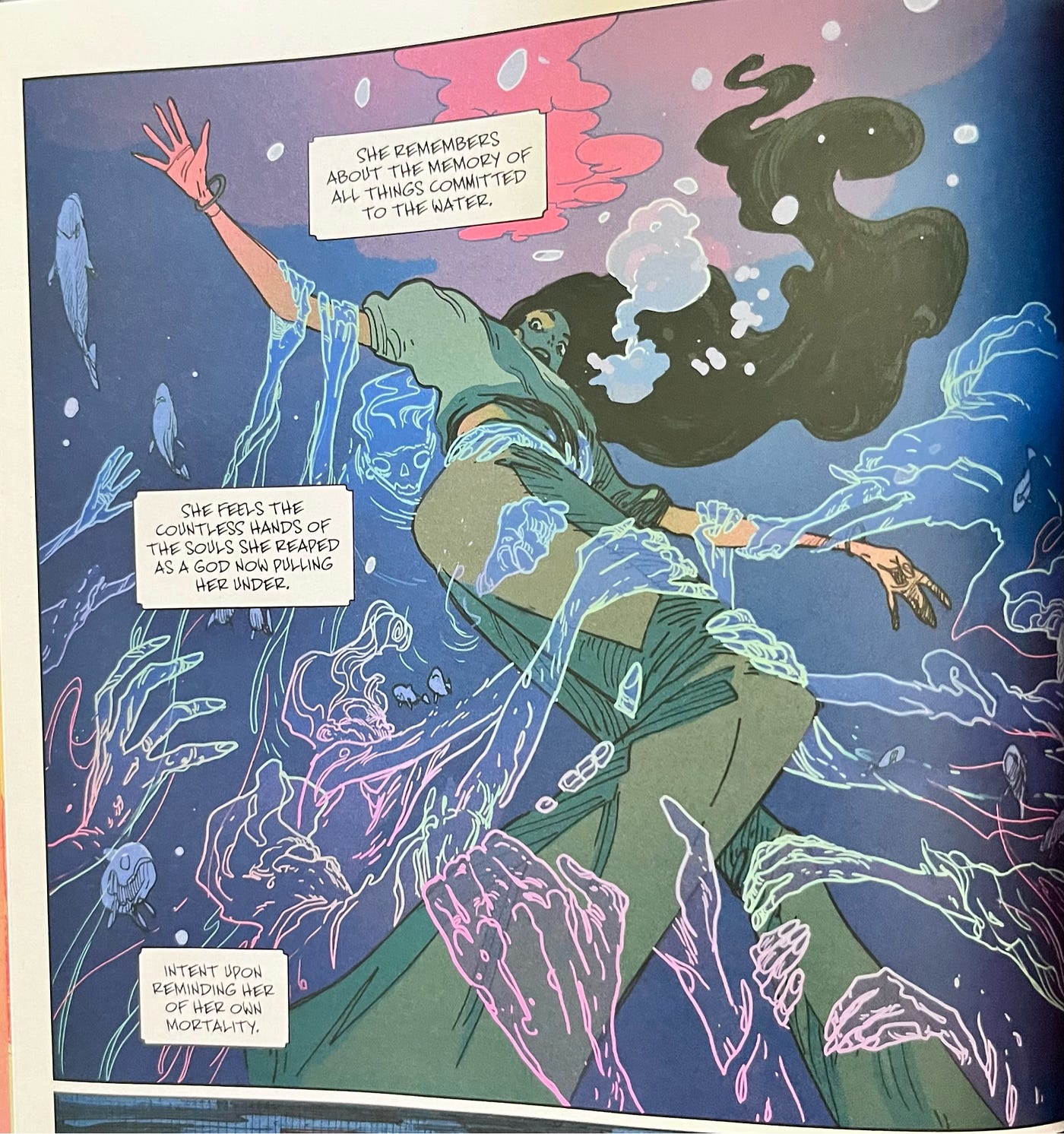
When Darius leaves Death, she chases him through the crowd, unsure of why she does so, and when she hears someone call his name, recognizning who she has just spoken with, the water creeps about her and drags her under the surface. She remembers Kah’s words as “she feels the countless hands of the souls she reaped as a god now pulling her under.” She thinks about her own mortality now and the fact that she can, physically, die. She feels the past pulling her. She feels the memories. They still exists, populating the depths, pulling her under before Kah rescues her.
I don’t want to give anything away, but The Many Deaths of Laila Starr foregrounds these discussions of death and memory, highlighting how one can let loose this mortal coil but still exist, due to memory and those who continue to tell the stories of the individual who has passed. We do not know what physical death brings. We do not know the two great mysteries of our existence, our physical birth and our physical death. We do know, though, that even after our physical death we continue to exist in the hearts and minds of those who keep our memory alive. A part of us sustains, even as the ground, fire, or water, take our bodies. This assurance consoles me because it reminds me that what I do today will continue into the future.
What are your thoughts? As usual, let me know in the comments below. Make sure to follow me on Twitter @silaslapham.
 Interminable Rambling