
At least once a year, I assign an unessay project and essay in my classes. I’ve written about this numerous times, and while I am always nervous about what the students will produce, because fear and apprehension keep them from really leaning into the project, I end up standing in awe at what the students end up producing for their unessay project. Last semester, I had students in my Lost Voices in American Literature course do unessay projects, and the students, again, amazed me with the things that they created, connecting their products to the texts that we read and also to their own interests.
Initially, students seem dumbfounded at the prospect of creating something then writing an essay about what they create. While I mention the unessay at the start of the course, it is not due until the end, so I continually, over the course of the semester, bring it up, helping students to think about how to connect what we read and discuss in class to their major or just one of their many interests. Typically, this helps, because in our conversations, I ask them pointed questions regarding their majors, goals, and more, thinking about ways to tie those things back into what they seek to create for the unessay project. I’ve found that while this process isn’t full proof, it does work to help students understand that the unessay project isn’t just something they can pull out of the air. It’s something that requires thought and work.
Last semester, I again sat amazed at some of the products that students produced for the unessay project. One student struggled with what to produce for their project. The student, initially, wanted to do something historical, and since they are an athlete, they wanted to look at the ways that individuals responded to Jesse Owens or Jackie Robinson or Shoehi Othani. The student wanted to do this because of the community’s reaction to Titus Crown being the first Black sheriff of Charon County in S.A. Cosby’s All the Sinners Bleed and the community’s reactions to Chinese detective Edison Hark in Pornsak Pichetshote and Alexander Tefengki’s The Good Asian. The more the student thought about this, though, they decided to do something completely different.
The student chose to create a short playable video game based on Ernest Gaines’ In My Father’s House. Essentially, the game was an old school RPG where the player, in the character of Rev. Philip Martin, goes through the story, interacting with characters and engaging in conversations, either chosing the “right” answer (i.e. the one in the book) or the wrong answer. The student made it look like an old 8-bit NES game, and while the student only had two conversations within the section they produced, the fact that they created such a product made me excited because it highlighted the power of unessay projects. Unessay projects call upon students to think about the material they learn and how to convey those ideas in different mediums instead of the usual “academic essay.”
Another student decided to do a play through of the indie game Never Alone (Kisima Ingitchuna), a game centered on a folktale from the Iñupiat tribe in Alaska. The game uses the Iñupiat language, a language that is considered threatened because even though 10,500 people in Alaska claim Iñupiat heritage only 5,600 people speak the language. The student, who streams games online, wanted to this because they kept thinking about themes we covered during the course of the semester, specifically the ways taht Annette Clapsaddle’s Even As We Breathe gives contemporary voice to the Eastern Band of the Cherokee Nation.
A theater student, thinking about the cultural appropriation and representation in R.F. Kuang’s Yellowface, chose to do a costume book for a stage adaptation of the novel. The student went it great detail about all of the scenes that would be in the adaptation and the costumes for each character, even pointing out the ways that color, the addition and removal of clothing, and other aspects connected to the themes in the book. A couple of psychology students also looked at Yellowface, creating in-take forms and psychologcial evaluations for the narrator June Hayword. One detailed sessions with June while another diagnosed June with narcissistic personality disorder.
A math student blew me away, even though I didn’t totally understand their project. The student, who is from South Africa, compared Apratheid in South Africa and Cherokee Removal in the United States. The student could have just done an essay or presentation to make these comparisons, but the student did more than that. The student chose to represent these atrocities and comparing them through a mathematical proof, establishing lemmas and drawing conclusions. Not being a mathematician, I did not completely understand what the student did; however, I was blown away that the student used a mathematical proof in this way, bringing their own expertise to the material in the course. Again, this is why I have students do unessay projects, so they can use their skills to show that they acquired knowledge over the course of the semester.
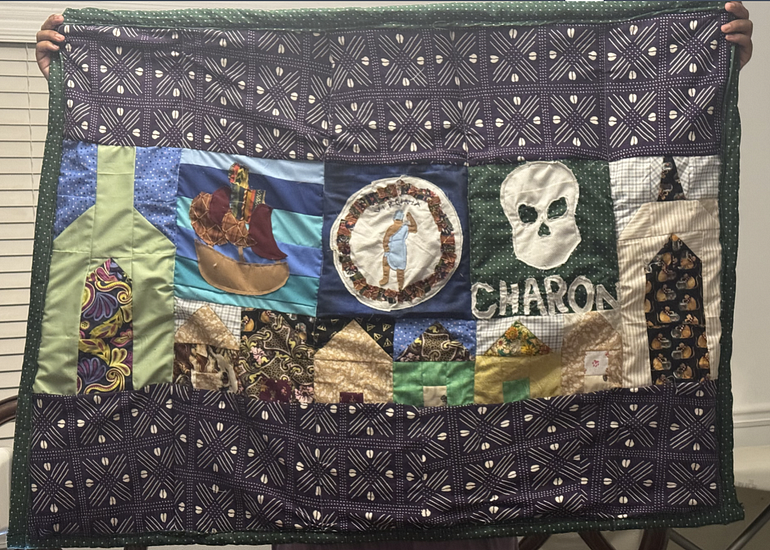
Finally, a student used her crafting skills to make a quilt based on S.A. Cosby’s All the Sinners Bleed. The student added so many parts to teh quilt from the Virginia state flag and the colonist’s boat to the skull representing all of the violence and death in Charon County’s history to Titus and Albert Crown’s house surrounding by the rest of the community to the two churches in the community, Jamal Addison’s new church and the older Black church where Albert attends. The student chose to do this because they craft, but also because of the history of quilting in the African American community from quilts being used as maps for the Underground Railroad to items that link families together across generations. The student chose to make the quilt out a pari of overalls and chose to add cowrie shells in order to represent charms used by African Americans to resist enslavement.
While I worry about what students will create whenever I assign unessay projects, I always come away inspired by the products they craft and how they tie those produce back into the material we learned in the course. I do these assignments for a myriad of reasons. As I’ve said, I do them because I want students to be able to express themselves and to learn different ways to convey information to others. They have to think about this with the project, especially when they write their reflection about the choices they made in creating it. As well, I do this assignment because I want students to realize that what they learn in class does not stay in that class. I want them to know that they must think about their courses as interconnected roots underneath the surface, talking to one another and learning from one another. Finally, I want students to showcase their own skills and hobbies, allowing them go express themselves and share knowledge in a way that feels good to them.
What are your thoughts? Have you done unessay projects in class? Are you thinking about it? As usual, let me know in the comments below. Make sure to follow me on Bluesky @silaslapham.bsky.social.
 Interminable Rambling