
When most people think about racism and oppression they think about the oppressed. They think about individuals who live under the heel of the oppressor. They think about the atrocities that the oppressor commits. They think about the acts of resistance against the oppressor. They do this and then they label it “the Negro problem” or “the Jewish question,” placing the onus of the violence on the victim, placing them as the ones who somehow caused their own oppression. This framing ignores the reality of the situation and erases the oppressor.
Lillian Smith points out, constantly, that when whites would say “the Negro problem,” they would be “projecting upon the Negro the millstone that our conscience has hung around our own soul.” Whites, as she continues, “don’t know why and have never known why the Negro is a ‘problem.’” Simply put, whites simply tell themselves that he is a problem. Science tells us, even when Smith wrote these words in 1943, that no differences exist in “mind or body” between Blacks and whites, but people don’t want to believe science and continue shouting about the problem.
We do not look, as Smith continues, at the Nazis’ atrocities against Jewish individuals and talk about it as the “Jewish problem.” No, we talk about the Nazis’ atrocities. “We talk about anti-Semitism,” Smith writes, “We focus on the crux of the conflict and keep our eyes fixed there.” However, here, instead of fixing our attention on the conflict, “we attempt to push the conflict outside ourselves, on to another.” Whites create the “problem” in order to deflect and justify oppression. What should happen, though, is that whites should fix their attention on themselves, asking themselves, “Why did I create this problem in the first place? What purpose does it serve for me to see others as a problem and not myself?”
Twenty years after Smith’s words, James Baldwin made the same point. During a 1963 interview, he highlighted the ways that whites constructed and created race in order to increase or maintain their positions of power. Baldwin said, “What white people have to do is find out in their own hearts why it was necessary to have a n***** in the first place.” He begins by getting to the foundation of the issue, that the “problem” didn’t exist until individuals created it. He continues, “Cause I’m not a n*****. I’m a man. But if you think I’m a n*****, it means you need him. The question you gotta ask yourself, the white population of this country, is gotta ask itself, . . . if I’m not the n***** here, and you the white people invented him, then you gotta find out why.” Baldwin echoes Smith by pointing out that the individuals who created the “problem” need to ask themselves why. They must engage in self-reflection, and once they discover the answer, they may have to engage in an act of self-violence through the extraction of the parts that connect them so closely to the creation and necessity they feel for the “problem.”
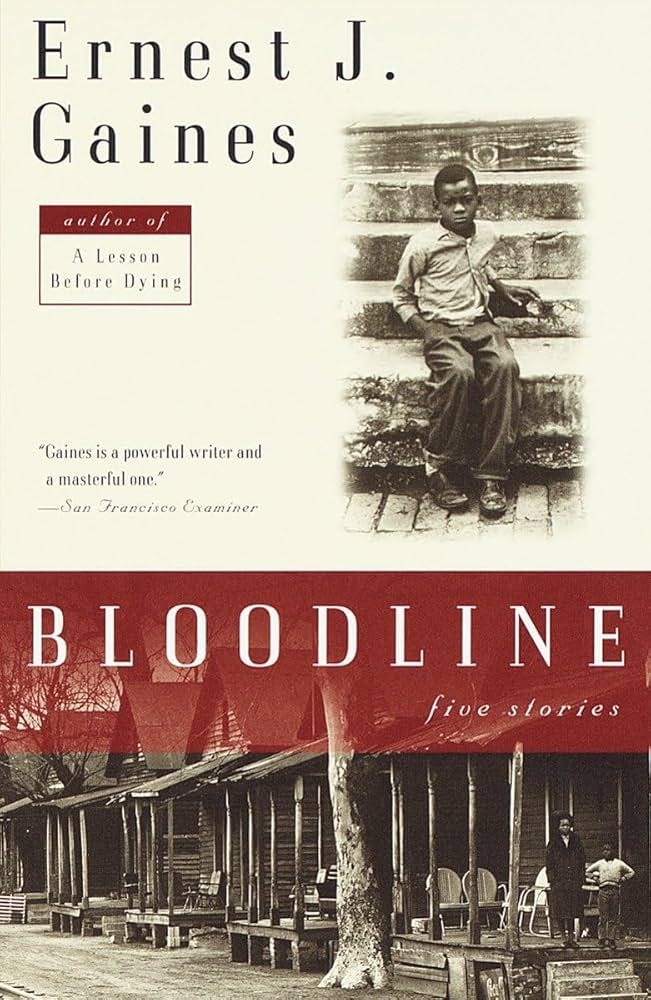
Just as Smith and Baldwin lay out the ways that whites construct race and language to maintain power, Ernest Gaines does the same throughout his short story collection Bloodline. Narrated by Procter Lewis, a Black teenager turns himself in to the authorities after he kills another man in self defense, “Three Men” takes place entirely in a jail cell, focusing on the interactions between Procter, Munford Bazille, Hattie, and a young, fourteen-year-old boy who enters at the end of the story. Munford is the old timer, in and out of jail for years, and he tells Procter to not let Roger Medlow bail him out of jail because if he lets Medlow bail him out he will become part of the system, going in and out of jail till he dies.
After Procter tells Munford about the fight that gets him in jail, Munford responds, “You killed another old n***** . . . A n***** ain’t nobody.” For Medlow, the jailers, and the powerful whites, Procter merely killed a Black man, nobody “important,” and they want to use him again and again to create violence. Munford then proceeds to tell Procter about his scar and how he started going in and out of the jail to the point where the judge would ask him how he’s doing and the guards would say, “Look, y’all, old Munt’s back with us again, just like he said he’d be.” Munford tells Procter all of this, and he tells him to not follow his example, to not allow Medlow to bail him out only for him to come back.
Hattie, a Black gay man, looks up and merely says, “Places like these are built for people like you. . . . Not for decent people.” Hattie distances himself from Munford, but in the comment he also points out the role that jails play in policing Black individuals such as himself, Munford, and Procter. They exist as a means of control for the “problem” that the white psyche created, the stereotypes of violence and hypermasculinity and hypersexuality. The created myths concocted to placate the soul and to acquire power. Munford himself, in response to Hattie, even lays this out.
Munford echoes Baldwin when he tells Procter and Hattie that he woke up to the situation after years of succumbing to the image of him that whites had, the image of him as a “problem” that he, not them, must solve. He tells them, “Then I realized they kept getting me off because they needed a Munford Bazille. They need me to prove they human — just like they need that thing [Hattie] over there. They need us. Because without us, they don’t know what they is — they don’t know what they is out there.” The labels that whites put on Munford, Procter, and Hattie serve as a means of the white telling themselves who they are by telling themselves who they aren’t. Munford continues, “With us around, they can see us and know what they ain’t. They ain’t us.”
Smith, Baldwin, and Gaines each point out the ways that whites create the “problem” and must face themselves, asking themselves, “Why did I need to create this problem in the first place?” Smith ends her 1943 essay “Putting Away Childish Things” by reiterating that “it is not the Negro Problem.” Rather, it is a constructed problem, and “for each white [it is] the problem of learning to live a good life with himself,” to become fully human and to cast off the myths they have created. This does not come easy, as I’ve written about before, but it must be done.
I will continue this discussion in the next post, looking more at Gaines’ stories and Smith. Until then, what are your thoughts? As always, let me know in the comments below. Make sure to foll
 Interminable Rambling