
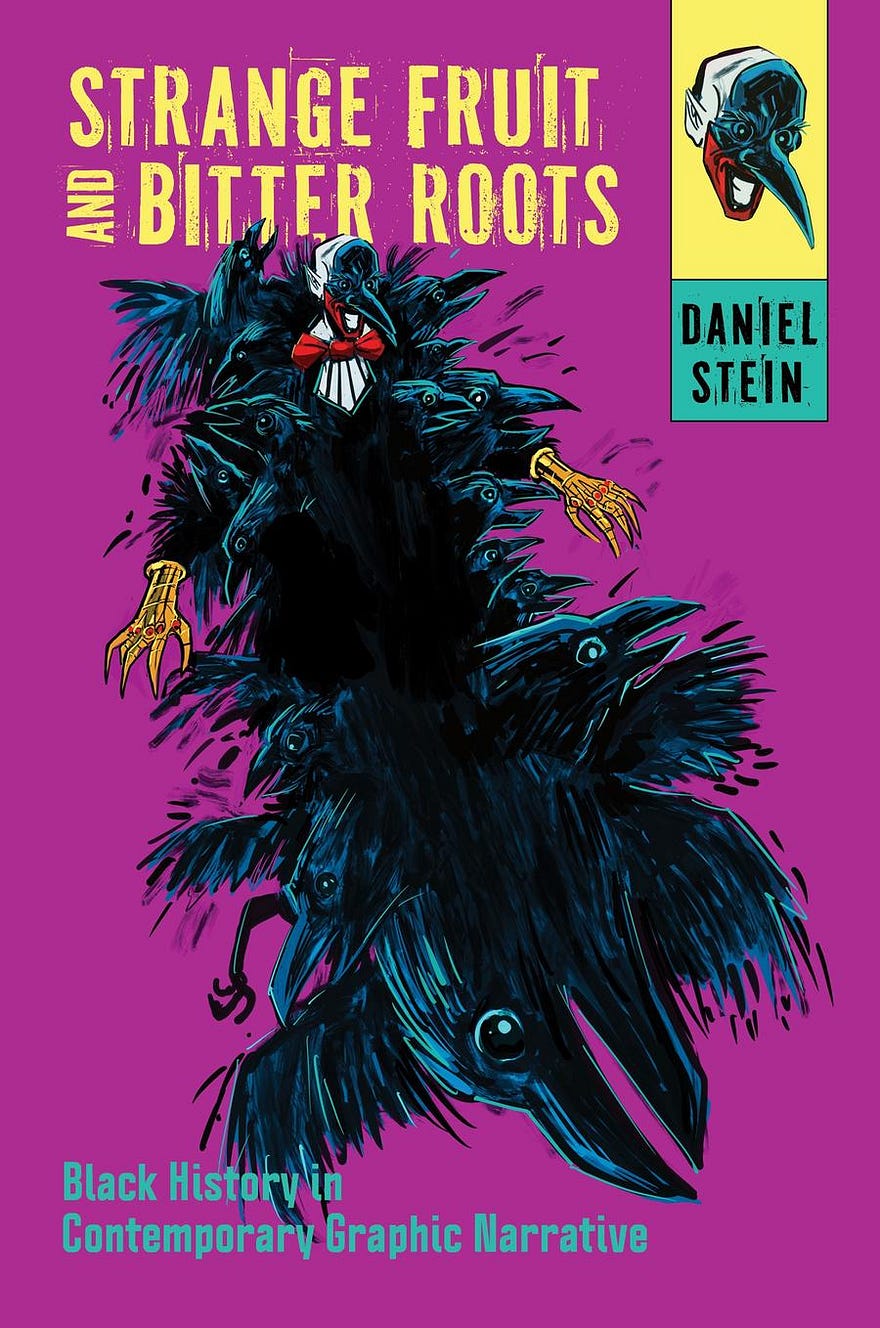
From the moment I heard about Daniel Stein’s recent book, Strange Fruit and Bitter Roots: Black History in Contemporary Graphic Narrative, I knew I wanted to read it, specifically because Stein examines numerous texts that I have used or plan to use in my courses. Stein offers a lot over the course of Strange Fruit and Bitter Roots, moving from an exploration of graphic narratives such as Rebecca Hall and Hugo Martínez’s Wake: The Hidden History of Women-Led Slave Revolts that engage with the Middle Passage to Mat Johnson and Warren Pleece’s Incognegro which deals with Jim Crow and lynching to Afrofuturist narratives such as Ta-Nehisi Coates’ Black Panther run to EthnoGothic narratives such as Chuck Brown, Sanford Green, and David Walker’s Bitter Root which use monstrosity and the gothic to illuminate the continuing impacts of enslavement, Jim Crow, and white supremacy.
Strange Fruit and Bitter Roots seeks to, as Stein puts it, “grapple with what Michael A. Chaney has called ‘the archive of racist visualization,’” and to do that, Stein sets out to answer the following question about the texts that he explores over the course of his study: “How do they tease out established and entrenched visions of Black history that carry inbuilt racialized assumptions to revise those ideas and project more complex, more inclusive, and more affirmative visions of Black life, art, and culture?” This question, for me, makes me think about the current course I’m teaching on Black Panther and the ways that Don McGregor and Billy Graham, in the Jungle Action story arcs, seek to present a progressive image of T’Challa but still manage, as Anna Peppard and others note, to fall into “racialized assumptions” and images of Black suffering when we see T’Challa bound to a cross, fighting animals, and other moments of brutality against him.
In working with “the archive of racial visualization,” Stein confronts the issue that many of the creators that he examines encounter, namely “the difficulty of producing graphic narratives of Black history that are grounded in recorded facts even though those facts are scarce or slanted toward anti-Black perspectives.” This issue arises at various points in Strange Fruit and Bitter Roots, most notably in Hall and Martínez’s Wake and Kyle Baker’s Nat Turner, both of which draw upon archival and historical research, and both of which face the issue of having to fill in the gaps within the archive and to reconstruct the narratives of individuals from their own perspectives, not those of their enslavers or chroniclers.
This archival gap is something I think about often, and I constantly return, again and again, to my own work in the archives and the semester that I had students work with archival materials when I taught at Auburn University. There, the archives for the antebellum period only contain materials from enslavers, not the enslaved. Thus, when students looked at items, all they saw was the enslavers’ perspectives, which filled their journals, bills of sale, and other items. One bill of sale stands with me because it drives home the conudrum that Stein, Hall, Martínez, Baker, and others seek to address in their work. The bill of sale had no names. It only had, on one side, five or six numbers with a tabulation. The other side merely proclaimed it was a bill of sale from one enslaver to another. I do not know who the numbers were, their stories, their lives. I know they existed, but that is all. Like Stein and the creators, I worked, with my knowledge, to give them life, through a story I wrote a few years ago.
Each of the creators that Stein explores in Strange Fruit and Bitter Roots uses knowledge to bring those individuals who have been lost in the archives and history to our consciouness. The creators do this from enslavement through lynching through the present. Jeremy Love’s Bayou and Johnson and Pleece’s Incognegro both deal with the legacies of lynching, a legacy that Asraf Rushdy points out exists as a “collective American amnesia,” lingering in the ether but never coming fully to light within the collective consciousness. Stein details the ways that Love, Johnson, and Pleece each, through their depictions of lynching, repudiate the commodification and carnival aspect of white supremacist violence. They do this by provided cultural touch points to their images where individuals know the original and fill in the blanks while also honoring and shifting the gaze of the reader away from the violence enacted upon African American individuals. This move reminds me of Reginald Marsh’s This is Her First Lynching where we see the perpetrators of the violence, not the victim of the violence, thus placing the weight of the act on the perpetrator and condemning them.
Stein ends with perhaps the most engaging part of Strange Fruit and Bitter Roots where he uses John Jennings and Stanford Carpenter’s the EthnoGothic to look at Jennings and Ayize Jama-Everett’s Box of Bones, Rob Guillory’s Farmhand, Brown, Green, and Walker’s Bitter Root, and more. Jennings describes the EthnoGothic as a genre that “uses gothic tropes like the ghosts, the haunted house, the doppelganger, haunted artifacts to deal with those traumas” of the racial violence. Monstors and monstrosity play into this because, as Stein notes, “there is a prominent conjunction of monstrosity with blackness that we find in Western discourse, a conjunction that takes on specific meanings in colonial and postcolonial North America as the subjugation of Black subjects had to be defended against the egalitarian rhetoric of the nation’s founding documents.”
The texts that deploy the EthnoGothic use these tropes to confront the trauma of the past but also to counter “the archive of racist visualization.” They do this by repurposing racist imagery to expose the true history of the nation, notably in moments such as depiction of whites whites being lynched with Sambo imagery on the “I am Wretched” tree in Jennings and Jama-Everett’s Box of Bones and through the Jino in Brown, Greene, and Walker’s Bitter Root. These moments and works, as Stein states, expose “the monstrosity of anti-Black violence and the anguish it causes,” and they provide “a significant intervention into the hegemonic,” and I would add archival, “narratives of US history, with their proclivity toward war heroes and visions of imperial greatness, suggesting that the nation has for centuries waged was on radicalized minorities.”
I cannot cover everything that Stein discusses in Strange Fruit and Bitter Roots. Over the course of his study, he looks at the ways texts such as John Lewis, Andrew Aydin, and Nate Powell’s March provide pedagogical moments through graphic texts, and how some of these works provide moments of joy and respite. What makes Strange Fruit and Bitter Roots important is the depth and breadth of Stein’s engagement with contemporary texts that have appeared, since their release, in classrooms all over the world. Stein’s book provides critical insight into these works and serves as a foundation for further research and for pedagogical approaches to these texts and others in the classroom and beyond.
What are your thoughts? Have you done unessay projects in class? Are you thinking about it? As usual, let me know in the comments below. Make sure to follow me on Bluesky @silaslapham.bsky.social.
 Interminable Rambling