Category: John Jennings

+

Leaving Children Behind: The Policing of Black Students

Recently, I picked up a copy of APB: Artists against Police Brutality, an anthology of comics and essays edited by Bill Campbell, Jason Rodrguez, and John Ira Jennings. In the introduction to the collection, Campbell points out that the “project was borne out of anger,” specifically the anger that he felt the night that a grand jury in Staten Island decided not to put … Read More Leaving Children Behind: The Policing of Black Students

+

LES Center Videos: III

In early December, I shared two posts with some of the weekly videos that I have been creating for the LES Center. Since then, I have created more videos, and I wanted to take a moment to share some of them with you today. These videos focus on talks she had with campers at Laurel Falls about racism, the ways that Smith connected her … Read More LES Center Videos: III

+

Empathy in John Ira Jennings and Damian Duffy’s “Parable of the Sower”

During the camp season at Laurel Falls, Lillian Smith would write letters home to the parents of campers. In the mid-summer 1946 Laurel Leaf, she wrote to parents about the adventures of Buss Eye, the plays that the girls wrote, and other camp activities. Near the end of the letter, she writes about the conversations that the campers had after hearing about the lynching … Read More Empathy in John Ira Jennings and Damian Duffy’s “Parable of the Sower”

+

The Ethnogothic

Recently, I finally had the chance to read all of David Walker, Chuck Brown, and Sanford Green’s Bitter Root vol. 1. In “Deep Roots/Rich Soil: Race, Horror and the Ethnogothic” (a back matter essay to Bitter Root), John Ira Jennings lays out what him and Stanford Carpenter call the “EthnoGothic,” a term I want to look at some today in relation to Bitter Root … Read More The Ethnogothic

+

Intimacy and Hope in Duffy and Jennings’ Adaptation of Butler’s “Kindred”

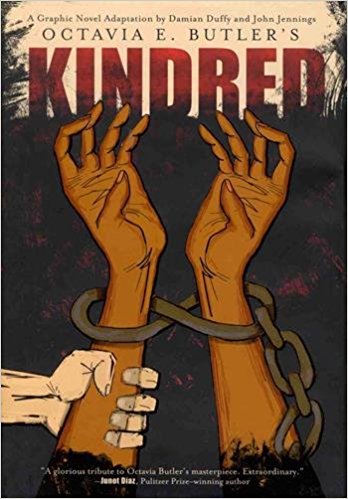
The last time I read Damian Duffy and John Ira Jennings’ graphic novel adaptation of Octavia Butler’s Kindred (1979), I zeroed in on the ways that Jennings represents faces and emotion in the text, specifically through Dana, Sarah, and Rufus. In this read through, I noticed the multiple panels with hands, either embracing, playing, or in confrontation. Today, I want to take a moment … Read More Intimacy and Hope in Duffy and Jennings’ Adaptation of Butler’s “Kindred”