Category: southern literature

+

Ernest J. Gaines’ “A Gathering of Old Men” and the Social Construct of Race

If you enjoy what you read here at Interminable Rambling, think about making a contribution on our Patreon page.  Recently, I spoke with a colleague’s class about Ernest J. Gaines and specifically A Gathering of Old Men (1983). During the question and answer period, two students asked questions that made me start to think about the ways that Gaines, throughout his entire career, challenges … Read More Ernest J. Gaines’ “A Gathering of Old Men” and the Social Construct of Race
Soundtrack Assignment in the Literature Classroom

Every semester I try something new in the classroom. Sometimes this may involve adding activities such as the fish bowl, working in the archives, or having students write on the board to generate ideas. I take these ideas and tweak them as I go along because, as we know, every class is not the same. What works in one class may not necessarily work … Read More Soundtrack Assignment in the Literature Classroom

+

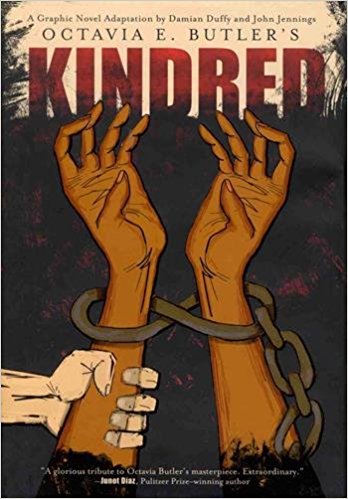
Literacy in Octavia Butler’s “Kindred”

Note: For this post, I will use Duffy and Jennings’ adaptation of Butler’s Kindred. I have read Butler’s novel, but it has a been a few years. The adaptation closely follows the novel. On Tuesday, I wrote about the ways that Damian Duffy’s illustrations convey just as much emotion to the reader as Octavia Butler and John Jennings’ words in the graphic novel adaptation of … Read More Literacy in Octavia Butler’s “Kindred”

+

Conveying Emotion in Duffy and Jennings’ Adaptation of Octavia Butler’s “Kindred”

One of the key aspects of reading comics and graphic novels is paying attention not just to the words but also to the visual images that accompany them. Both the words and the images work together to create an experience that, to me, resembles a melding of a printed text and movie. When I read the March trilogy and The Silence of Our Friends, … Read More Conveying Emotion in Duffy and Jennings’ Adaptation of Octavia Butler’s “Kindred”

+

Frank Yerby’s “Health Card” and Gender

Before he started writing “costume novels,” Frank Yerby penned protest literature in the form of short stories and poems. The stories are in the vein of Richard Wright and other African American writers of the period. After failing to get his first novel length manuscript published, a protest novel, Yerby turned to what he called “costume novels,” historical narratives that subvert the plantation tradition. … Read More Frank Yerby’s “Health Card” and Gender